

Blog / LinkedIn
What to Post on LinkedIn as a B2B Business Owner: The Honest Guide

Post the questions your clients ask, the mistakes buyers make in your sector, how your service really works and what you have learned. Two or three times a week is enough, and consistency matters far more than volume.
You know you should be posting on LinkedIn. You have probably told yourself you will start properly for the past six months. Maybe you have even opened the app, stared at a blank text box, thought of nothing worth saying and closed it again.
You are not alone in this. In over fourteen years of working with B2B businesses, I have had this exact conversation hundreds of times. Business owners who are genuinely excellent at what they do, who have real expertise worth sharing, who understand perfectly well why visibility matters, and who still cannot seem to post on LinkedIn consistently.
This guide is not going to tell you to post motivational quotes or share your morning routine. It is going to tell you exactly what works, why it works and how to keep it going when the business gets busy.
Why LinkedIn Matters More Than Most B2B Owners Realise
Most business owners still think of LinkedIn as social media. It is not.
For B2B businesses, LinkedIn is where buyers go to verify that a business is worth contacting. Before picking up the phone or sending an email, a growing number of buyers will check your LinkedIn profile to answer a very simple question: does this business look active, credible and worth my time?
Think about what a buyer is actually looking at when they land on your profile. They want to know whether you are still active. Whether you understand the problems they are dealing with. Whether you look like someone they could trust. Whether there is any evidence that other people have found you useful.
An active LinkedIn presence answers all of those questions before you have spoken to anyone. An inactive one leaves buyers uncertain, and in a competitive market, uncertainty is enough to push someone towards a supplier that looks more visible and easier to understand.
The Real Reason Most Business Owners Do Not Post
It is worth spending a moment on this because the reason matters. It is not that business owners do not understand the value of LinkedIn. Almost all of them do. It is not that they have nothing worth saying. Every business owner I have spoken to has years of genuine expertise that buyers would find useful.
The real reasons are almost always a combination of these:
They do not know where to start
There is a difference between knowing you have things worth sharing and knowing how to turn those things into LinkedIn posts. Most business owners have never been taught how to think about content, so they overthink every post until it feels like too much effort.
They are afraid of getting it wrong
Afraid of sounding salesy. Afraid of looking like they are showing off. Afraid of posting something that gets no engagement. These fears are understandable and they are also the reason so many business owners default to saying nothing at all.
They have tried before and stopped
They posted six times in January, got a few likes from existing contacts and saw no obvious results. So they concluded LinkedIn does not work for businesses like theirs and went back to relying on referrals.
They simply run out of time
Running a business leaves very little room for sitting down and writing content. When something has to give, LinkedIn is always the first thing to go.
None of these are reasons to give up on LinkedIn. They are reasons why most businesses need a simpler, clearer system for making it work.
What Your Buyers Are Actually Doing on LinkedIn
Before I tell you what to post, it helps to understand what the person you want to reach is actually doing on the platform. B2B buyers use LinkedIn in three main ways.
They research businesses before making contact. When a referral arrives or a business appears in search results, a buyer will often check LinkedIn before reaching out. They are looking for evidence that the business is current and credible.
They passively consume content from people in their network. Most LinkedIn users scroll through their feed without engaging much. They read posts, absorb information and notice names. That passive consumption is how familiarity builds over time. A buyer who has seen your name and your content a dozen times before they need your service is far more likely to think of you.
They actively search for advice and solutions. When a buyer has a specific problem, they will often search LinkedIn for relevant content. This is where specific, useful posts about your area of expertise get found by people who were not already connected to you.
The Six Types of Content That Work for B2B Businesses
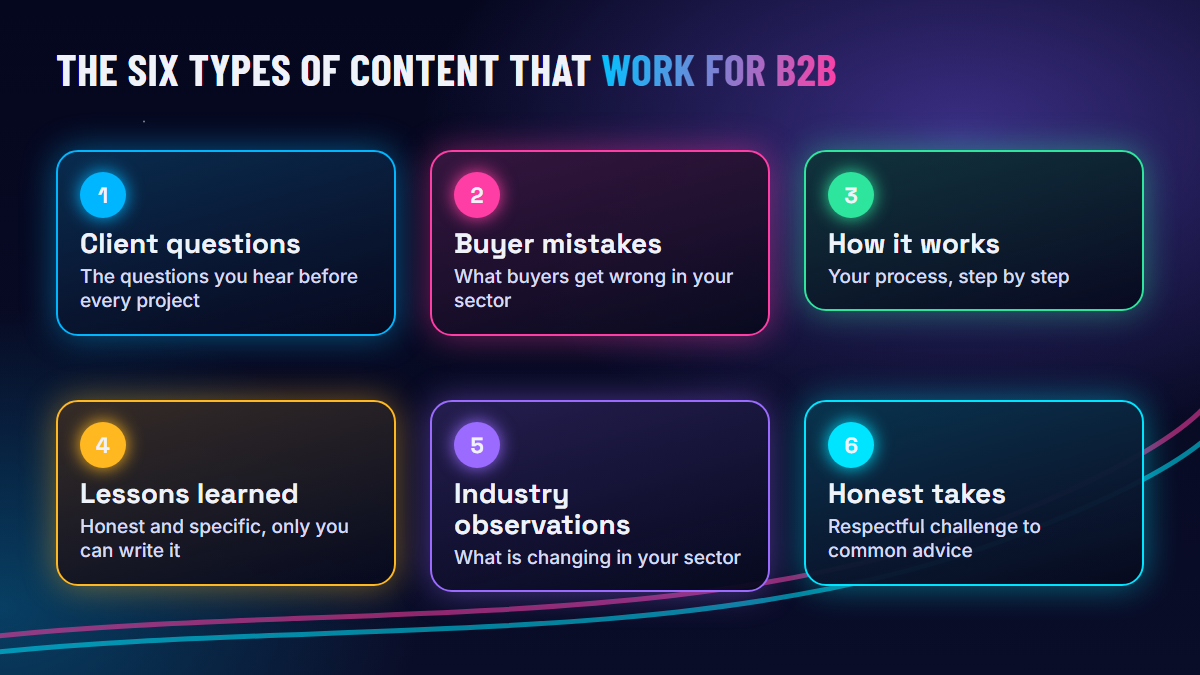
Every post you write should fall into one of these six categories. All of them are things you already know. None of them require you to become a content expert.
1. Questions your clients ask you
Before every client engagement, there are questions. Write down the questions you get asked most often and turn each one into a post. If one client is asking it, there are buyers searching for the answer right now.
2. Mistakes buyers make in your sector
What do buyers typically get wrong before they come to you? What assumptions do they make that cause problems later? Content that honestly addresses common mistakes positions you as someone who understands the problems your clients face better than they do themselves.
3. How your service actually works
Most buyers have a vague idea of what a service like yours involves. Explaining your process, what happens after someone becomes a client, what you need from them and what the typical timeline looks like, builds trust by making your work feel transparent and accessible.
4. What you have learned
Lessons from projects. Things that changed how you approach your work. Mistakes you have made and what they taught you. This kind of content is powerful because it is honest and specific, and it can only be written by you.
5. Industry observations
What is changing in your sector? What are you seeing more of in conversations with clients? What is different from two or three years ago? You are on the front line of your industry every day. Share what you are observing.
6. Honest takes on common advice
Every industry has advice that gets repeated endlessly that is oversimplified or incomplete. If there is something in your sector you think needs more nuance, post about it. Challenging common wisdom respectfully generates strong engagement and positions you as someone with genuine independent expertise.
The 18 Post Method
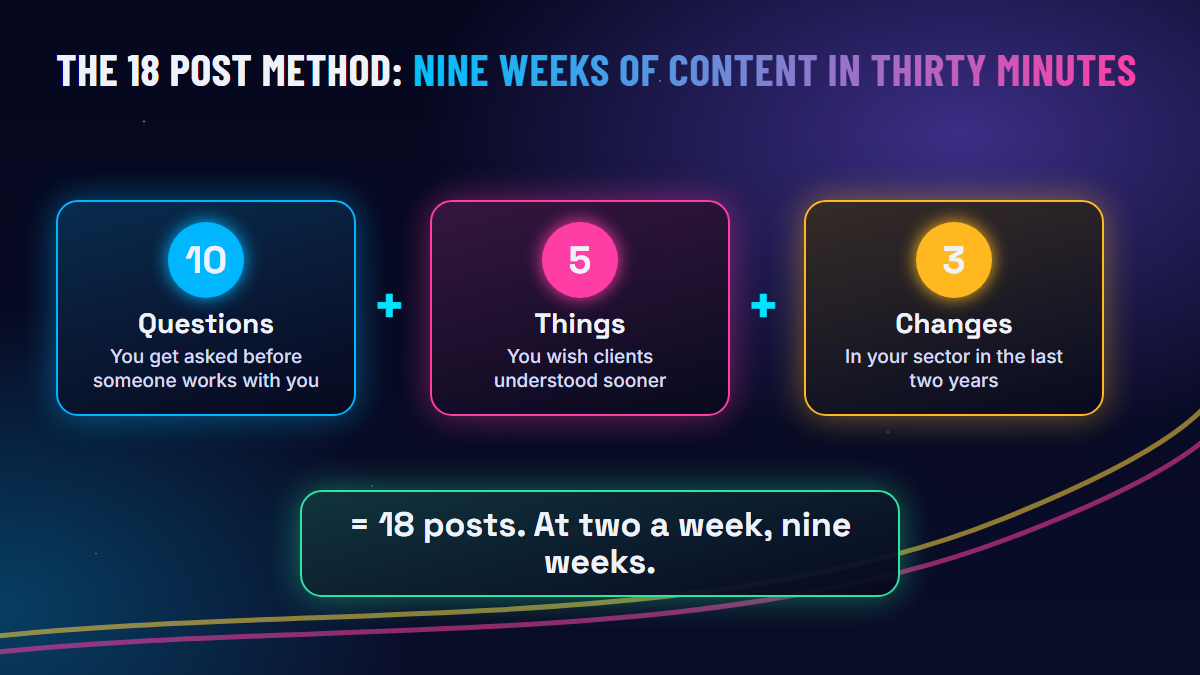
If you are still not sure where to start, here is the simplest possible way to build your first few months of LinkedIn content. Sit down for thirty minutes and write down the following.
- The ten questions you get asked most often before someone works with you
- The five things you wish more clients understood before they came to you
- The three most significant things that have changed in your sector in the past two years
That is eighteen pieces of content. At two posts per week, that is nine weeks of LinkedIn without having to think of a single new idea. Every one of those posts would be directly relevant to your ideal clients. Every one would demonstrate expertise without sounding like a sales pitch.
Personal Profile or Company Page
For owner led businesses, your personal profile will almost always generate more reach than your company page. LinkedIn is fundamentally built around person to person connection and the algorithm favours personal content.
Your company page still matters. It is one of the first places a buyer will look when researching your business, so keep it clear and current. But if you can only focus on one, start with your personal profile.
How Often You Actually Need to Post
Two to three times a week is the sweet spot for most B2B businesses. Not because there is anything magical about that number, but because it is the frequency at which buyers start to recognise your name.
More important than frequency is consistency. Someone who posts twice a week every week without fail will build far more recognition than someone who posts ten times in one week and then disappears for a month.
What Consistency Actually Does Over Time
The results from LinkedIn are rarely immediate, and that is the thing that causes most business owners to give up too soon.
But something happens over time that is harder to measure and more valuable. Buyers begin to recognise your name. They start to associate you with your subject matter. They develop a sense of your expertise before they have ever spoken to you. When the moment arrives that they need what you offer, you are already familiar to them.
Consistent LinkedIn posting also creates a body of public content that supports your wider online visibility, in Google and increasingly in AI search tools like ChatGPT, which reference publicly available content when buyers ask questions about suppliers in your sector.
The Honest Problem With Staying Consistent
Everything in this guide is achievable. The framework is simple. The posting frequency is not demanding.
The problem is finding the time and mental space to actually do it every week when the business is busy. This is not a motivation problem. It is a capacity problem. Running a business leaves very little room for writing content twice a week without fail, week after week, month after month.
How ThinkOnce Fixes the Consistency Problem
ThinkOnce creates and publishes done for you LinkedIn content for owner led B2B businesses, built around your business and published consistently every month, so your business stays visible to the right buyers even when you are completely flat out.
No writing. No briefing a social media company. No wondering what to post. Just consistent visibility, sorted.
Frequently Asked Questions
What should a B2B business post on LinkedIn?
Start with the questions your clients ask before working with you, mistakes buyers in your sector commonly make and honest explanations of how your work solves real problems. The things that feel obvious to you are almost always genuinely useful to the buyers you want to reach.
How often should a B2B business post on LinkedIn?
Two to three times a week is a sustainable and effective starting point. Consistency over time matters far more than posting every day. A business that posts twice a week every week will build more recognition than one that posts ten times in one week and then disappears.
Does LinkedIn actually generate B2B enquiries?
Not usually immediately. LinkedIn builds the familiarity and trust that leads to enquiries over time. Many buyers check LinkedIn before making contact and an active profile gives them significantly more reason to choose you over a less visible competitor.
Should I post on my personal profile or the company page?
For owner led businesses, your personal profile typically reaches more people. Both should be kept updated but if you can only focus on one, start with your personal profile.
What if nobody engages with my posts?
Engagement is not always visible. Many people read LinkedIn posts without liking or commenting. Consistency and usefulness matter more than chasing reactions. The results build quietly over time.
Is LinkedIn worth it for smaller B2B businesses?
Yes. Smaller businesses can often sound more human and specific than larger competitors. Consistent posting builds credibility regardless of company size.
What does ThinkOnce do?
ThinkOnce creates and publishes done for you LinkedIn content for owner led B2B businesses every month. Content is built around your business, relevant to your ideal clients and published consistently so your business stays visible without you having to find the time.
Not getting enough enquiries from your online presence?
See what might be holding your business back.
Want a simple plan to follow instead? The free guide walks you through it.

Elle helps UK owner led B2B businesses get found online. She writes about LinkedIn visibility, AI search and practical ways to win more of the right enquiries.
Keep reading

Business Growth
How to Get More Business: Be Found on Google, in AI and Through Referrals
Most owners do not need more tactics. They need to be easier to find, easier to trust and easier to recommend. Here is how, in order.
B2B Visibility
Why Your B2B Business Is Invisible Online, and How to Fix It Without an Agency
Good businesses lose work to competitors they are better than. Here are the four things holding most B2B businesses back online, and what fixing them looks like.

AI Search
How to Get Your B2B Business Found in ChatGPT and AI Search in 2026
AI tools build answers from public content. Here is what feeds them, why LinkedIn matters, and five things to do this week.